LED screen fabrication design
Get the steel frame for your LED screen drawn in 2D in seconds: surrounding pipe, back verticals at every cabinet joint, all dimensions, a cutting list and the steel weight. Free for LED screen builders and fabricators.
How to design the fabrication frame for an LED screen
An LED screen needs a steel frame (also called the LED screen structure or MS frame) that holds the cabinets flat, square and level. A good fabrication design puts a pipe behind every cabinet joint, leaves a small clearance around the screen and uses standard 6 m pipe lengths with little waste. The tool above draws this for your screen size automatically. Below is how the design works, so you can check it or explain it to your fabricator.
1. Surrounding frame
A square pipe runs all around the screen. On most outdoor and large indoor screens this is 100 × 100 mm MS or GI pipe with a 3 mm wall. The two side pipes run full height; the top and bottom pipes fit between them. The inner opening is the screen size plus the clearance on every side, usually 10 mm. For a 7680 × 4800 mm screen that gives a 7700 × 4820 mm opening and a 7900 × 5020 mm outer frame.
2. Back verticals at every cabinet joint
Smaller pipes, usually 40 × 40 mm, are welded on the back of the surrounding frame, full height. The middle verticals sit exactly on the joints between cabinet columns, so two cabinets bolt onto one pipe. The two end verticals sit half behind the side pipe: 20 mm behind it and 20 mm in the opening. With 960 mm cabinets the centre-to-centre spacing is 970 + 960 + … + 960 + 970, because the first and last bays include the 10 mm clearance.
3. Design A or Design B
Design A uses only the surrounding frame and the back verticals. It is the standard choice: less steel, less welding and enough for most wall-mounted screens. Design B adds 40 × 40 horizontals at every cabinet row joint, cut to fit between the verticals, plus 300 × 300 × 6 mm corner gusset plates. It is stiffer and is worth it for very large, free-standing or windy sites.
4. Depth, packing plates and the LED face
Packing plates between the back of the surrounding frame and the verticals set the depth, so the cabinets sit flat and the LED face stands slightly in front of the frame. The side section in the drawing shows the surrounding pipe, packing, vertical, cabinet and module in order from front to back.
5. Long pipes and splice joints
Pipe usually comes in 6 m lengths. When the top or bottom pipe is longer, for example 7700 mm, it is made from 6000 + 1700 mm and joined with a full weld and a 300 mm inner sleeve. Put the top joint and the bottom joint at different ends so they do not line up. The drawing marks these joints with a red box.
6. Cutting list and steel weight
The cutting list gives every member with its length and quantity, the total metres of each pipe and how many 6 m pipes to buy. Weight per metre of a square pipe is about 4 × wall × (size − wall) × 0.00785 kg. That is about 9.14 kg/m for 100 × 100 × 3 and 2.39 kg/m for 40 × 40 × 2.
Worked example: 7680 × 4800 mm screen, 960 × 960 cabinets
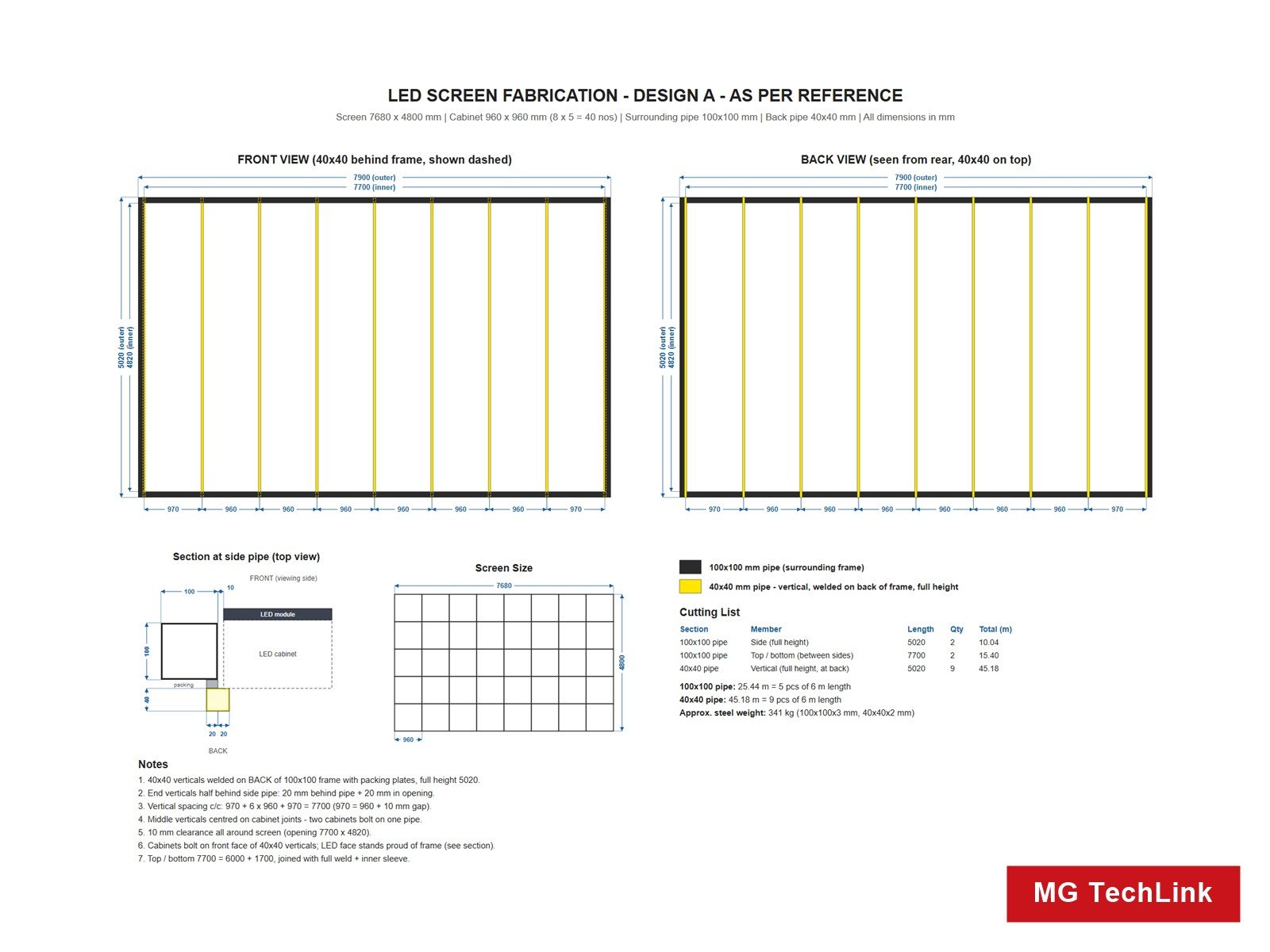
| Section | Member | Length (mm) | Qty | Total (m) |
|---|---|---|---|---|
| 100 × 100 pipe | Side, full height | 5,020 | 2 | 10.04 |
| 100 × 100 pipe | Top and bottom, between sides | 7,700 | 2 | 15.40 |
| 40 × 40 pipe | Vertical, full height, at back | 5,020 | 9 | 45.18 |
That is 5 pieces of 100 × 100 pipe and 9 pieces of 40 × 40 pipe in 6 m lengths, about 340 kg of steel. Both outer diagonals should measure 9,360 mm when the frame is square.
Checks before you fabricate
- Confirm the real cabinet size and the module size from the datasheet before cutting.
- Check the wall, the anchors or the pole and the wind load with a structural engineer.
- Measure both diagonals after welding; they must be equal.
- Leave access for power and data cables, and for service if the cabinets are rear-service.
- Paint or galvanise the frame for outdoor screens.
Frequently asked questions
What pipe size is used for an LED screen frame?
Most LED screen frames use a 100 × 100 mm MS or GI square pipe (3 mm wall) as the surrounding frame and 40 × 40 mm pipe (2 mm wall) behind the cabinets. Smaller indoor screens can use 80 × 80 or 60 × 60 mm. Always have the size checked for your site.
How many vertical pipes does an LED screen need?
One vertical behind every cabinet joint plus one at each end, so the number of verticals is the number of cabinet columns plus one. An 8-column screen needs 9 verticals.
How much clearance should be left around the LED screen?
About 10 mm on every side is common. It gives room to fit and adjust the cabinets inside the frame.
How do I calculate the steel weight of the frame?
Add up the metres of each pipe and multiply by its weight per metre: about 4 × wall × (size − wall) × 0.00785 kg per metre. The tool on this page does this for you and also counts the 6 m pipes to buy.
Can I print the fabrication drawing?
Yes. Use the "Print fabrication drawing" button and choose "Save as PDF" in the print window to get a PDF for your fabricator.
Is this fabrication design free?
Yes. It is a free tool from MG TechLink for LED screen builders and installers. The drawing is generated automatically, so please have it checked by a qualified fabricator or structural engineer before use.
© 2026 MG TechLink. The design and code of this tool are our copyright and may not be copied to another website or app. See our terms of use.
Need a price or a matching part?
Send us your parts list or just your screen size. We reply with prices, stock and the parts that go with it.